
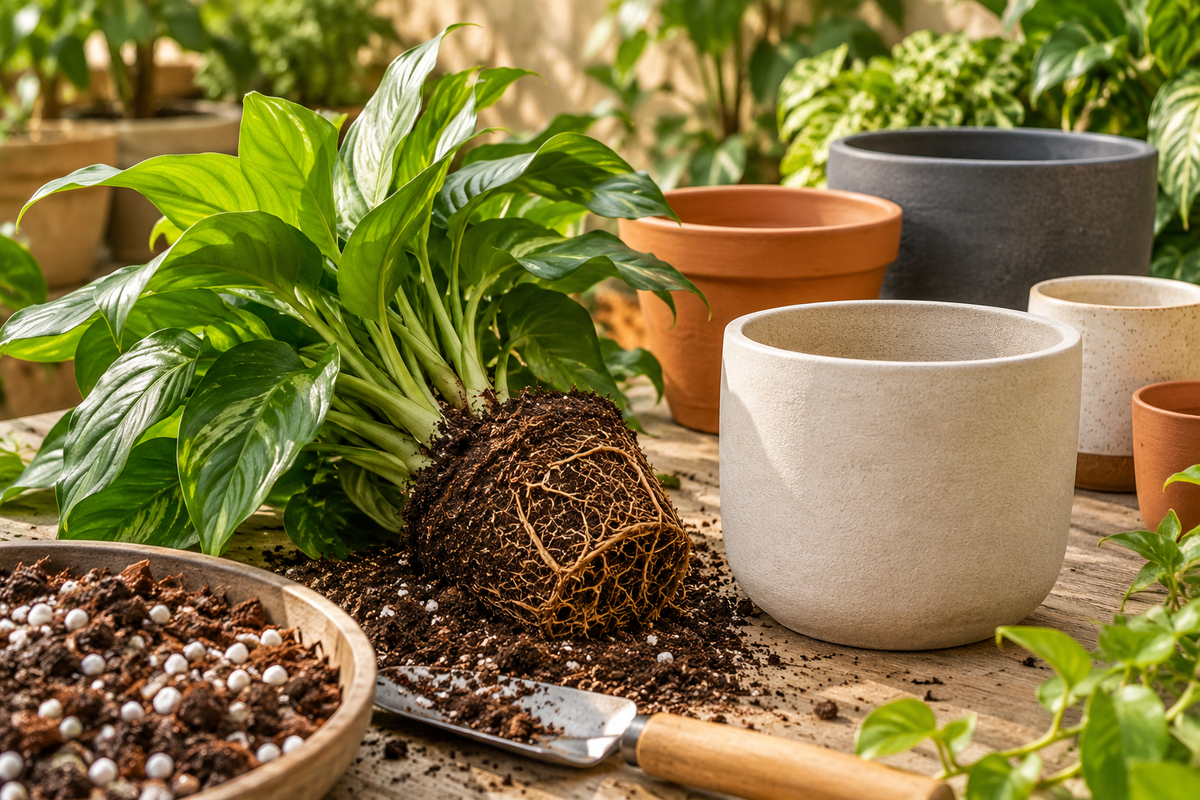
Choosing the right pot is about giving roots enough room, keeping water moving, and making the plant stable—not simply choosing the largest planter available. A pot that is far too large can stay wet for longer than the roots can use, while a pot that is too small dries quickly and restricts growth. Here is a practical way to choose a pot size and recognise when a plant is ready to move.
How to tell whether a plant needs repotting
One sign alone does not always mean repotting is needed. Look for a combination of clues:
- Roots are circling densely around the inside of the pot or emerging from drainage holes.
- The plant dries out unusually quickly despite normal conditions.
- Growth has slowed during the growing season even though light and care are suitable.
- The root ball comes out as a tight, pot-shaped mass with little growing mix left.
- The plant has become top-heavy or unstable in its current container.
Yellow leaves or slow growth can also result from watering problems, pests, low light or nutrient issues. Check those causes before assuming a larger pot will solve everything.
Use the next size up—not several sizes up
For many houseplants, moving to a pot roughly 2–5 cm wider than the current one is a sensible starting point. A fast-growing plant or a large root ball may need a little more room, while a slow-growing plant may not need repotting yet. These are guidelines, not fixed rules: compare the root ball with the pot and consider the plant’s growth habit.
Very large jumps in pot size leave a lot of unused mix around the roots. That area can remain wet for longer, increasing the risk of root stress, especially for plants that prefer to dry slightly between waterings. For a large floor plant, increase the size gradually and choose a container that is stable enough to support the foliage.
Match pot shape to the roots
Shallow or spreading roots
Plants with a relatively shallow root system may do well in a wider container rather than an unnecessarily deep one. A wide pot can also suit herbs and grouped seasonal plants, provided each plant has enough room.
Deeper or larger root systems
Plants that develop a deeper root system need adequate depth and a stable base. Check the specific plant’s needs rather than relying on leaf size alone to judge root space.
Trailing and climbing plants
Trailing plants do not always need a larger pot simply because the vines are long. Check the root ball first. For climbing plants, a support or trellis may be more useful than a much bigger container.
Drainage is non-negotiable
Choose a pot with drainage holes for most plants grown in potting mix. After watering, excess water should be able to escape. Do not let a nursery pot sit in a cachepot full of water. If you use a decorative outer planter without holes, keep the plant in a removable inner pot and empty collected water after watering.
In Bengaluru, showers and humid spells can leave balcony pots wet for longer than expected. Lift pots slightly off the floor where possible, keep drainage holes clear and adjust watering to the actual moisture in the mix. Do not follow a fixed daily schedule if the soil is still wet.
How to repot without stressing the plant
- Water lightly in advance if the root ball is very dry, so it holds together during removal.
- Prepare a clean pot with open drainage holes and fresh, suitable potting mix.
- Ease the plant out by supporting the root ball; do not pull hard on the stem.
- Loosen only tightly circling roots gently. Avoid aggressively tearing healthy roots.
- Set the plant at the same depth it was growing before. Do not bury the stem deeper unless the species specifically benefits from it.
- Fill around the root ball, firm lightly and water enough to settle the mix, allowing excess to drain away.
- Keep the plant in its usual suitable light, avoiding sudden extremes while it adjusts.
What kind of growing mix should you use?
Use a mix suited to the plant: aroids, succulents, herbs and flowering plants do not all want the same texture or moisture retention. The mix should support the roots while allowing air and excess water to move through it. Avoid compacting it tightly into the pot. Explore potting mixes and soil-care products and follow the instructions for the specific product.
Choose a pot that works for your space
Think about the plant’s mature size, weight when watered, sunlight, wind exposure and where excess water will drain. A balcony planter must be safe and stable as well as attractive. Browse pots and planters by style and size, or visit the eNGe Experience Centre in HSR Layout, Bengaluru if you would like to compare options in person.
Remember: repot when the roots and growing conditions call for it, not simply because a plant has been in the same pot for a set number of months. A correctly sized pot with good drainage is usually more helpful than a much larger container.
Shop pots and repotting essentials
When your plant needs a new container, compare our NURSERY Pot options and browse ceramic pots for decorative outer planters. If the existing mix has broken down, explore Potting Soil and choose a blend suited to your plant’s drainage needs.